4. The Mystery of the Amber Room

During World War II, Adolf Hitler's Nazis confiscated countless works of art from all over Europe. By the end of the war, billions of pounds worth of art had been scattered across four continents and Nazi looting had reached industrial proportions.
While some stolen works of art have been returned to their rightful owners, many others remain unclaimed, including the Amber Room or Hall, a priceless collection of exquisite amber panels. The Amber Room, often known as the 'Eighth Wonder of the World', was one of Russia's most valuable pieces of art until it was taken and lost after World War II by Nazi Germany.
During World War II, the German invasion of the Soviet Union (also known as Operation Barbarossa) put cultural works of art at risk of being looted by the Germans. Curators tried to hide the amber panels under ordinary wallpaper, hoping their trick would be enough to keep them from being stolen.
Adolf Hitler saw the works as German heritage and so wanted them returned to Germany. He sent a group of soldiers to the Catherine Palace, where they located the Amber Room behind its disguise and removed it for shipment to Königsberg Castle (now Kaliningrad in Russia).
It remained on display in Königsberg for the next two years, but when the tide of war turned in the Allies' favor and danger was imminent, Adolf Hitler ordered the transfer of looted goods and cultural artifacts to more remote areas within the German borders.
The Amber Room was most likely destroyed after the devastation of the castle, according to the de-encrypted documents from the Russian National Archives, written by Alexander Brusov (the leader of the Soviet team responsible for discovering the lost works of art). Three of the four Florentine mosaics in the Amber Room were discovered broken and burnt in the castle's cellar, according to his assessment.
Despite this, the Soviets continued to extensively explore the castle grounds to discover the Amber Room. It has been speculated that this was done as part of early Cold War propaganda to hide the fact that they were responsible for its destruction during artillery bombing, and not the Nazis.
Several unconfirmed eyewitnesses claimed to have seen the loading of the Amber Room on board the Wilhelm Gustloff, which left Gdynia in 1944 and was torpedoed and sunk by a Soviet submarine. The wreck has been explored several times without any tangible evidence that parts of it were on board.
Parts of the fourth Florentine mosaic in the Amber Room were discovered in the custody of the son of a German soldier who claimed to have stolen them during the dismantling of the room in 1941 or 1944 and were recovered by German officials in 1997.
Many ideas have been proposed as to the fate of the Amber Room as a result of these contradictory events, but no conclusive evidence has been uncovered. The best known theory is that it was destroyed at Königsberg or that parts of the Chamber are still concealed under the castle in a hidden vault. However, in 1968, Soviet General Secretary Leonid Brezhnev ordered the destruction of the castle, making any on-site research of the Amber Room's last known resting place almost impossible.
The most viable explanation, which is supported by Professor Alexander Brusov, the Soviet official sent to collect the stolen antiquities in 1944, is that they were destroyed by bombs and fires. Brusov is said to have discovered the charred remains of three of the four Florentine mosaics in the Amber Room in the castle's cellar. Anatoly Kuchumov, the official who had failed to secure the Chamber in 1941, did not accept Brusov's findings. He detained Brusov and initiated his own investigation with the help of the KGB, perhaps to distract attention from his own error.
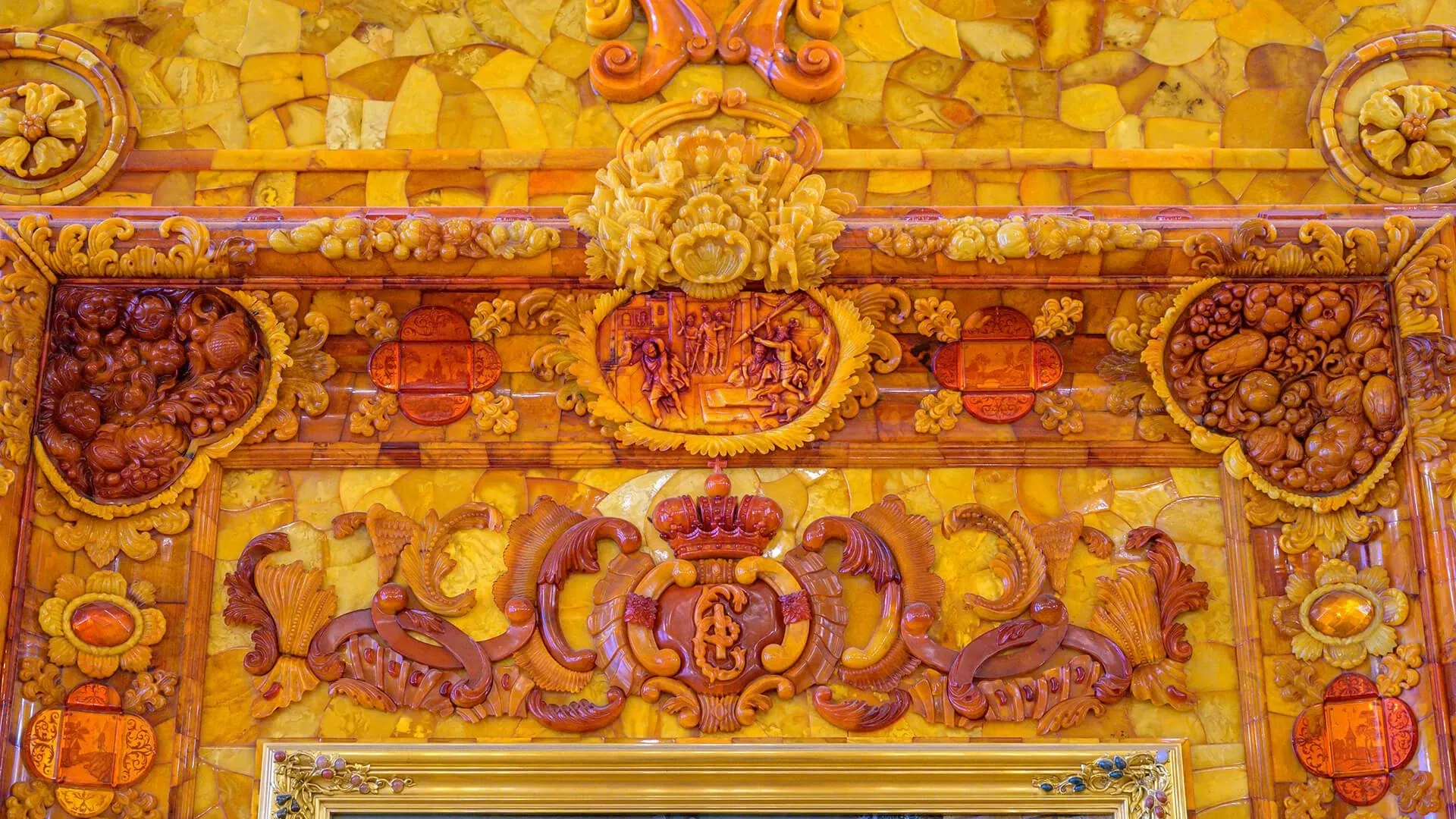
The project to rebuild the Amber Room took 24 years to complete, starting in 1979, with Russian President Vladimir Putin and German Chancellor Gerhard Schröder inaugurating the new Amber Room during the 300th anniversary of the founding of St Petersburg in 2003 (photo: Amber Room art details).
We hope this story has captivated you and that you are left with interesting information about the history of the famous Amber Room.
Similar posts

28. Discover the Charm of Amber: A Delight for the Taurus Zodiac Sign
Amber is truly a treasure for Taurus individuals. Its healing energy, strong connection to the Earth element, and sensual charm bring a series of positive aspects to their lives. This precious stone can be a reliable partner, offering balance, stability, and inner peace. Moreover, amber jewelry perfectly complements the refined and natural style of Taurus individuals, adding a touch of elegance and radiance.

27. Amber: An Anchor for Aquarius
For Aquarians, in particular, amber can have positive influences on essential aspects of their lives. This gemstone is known for its ability to stimulate creativity and innovative thinking, offering Aquarians inspiration and clarity in developing ideas and projects. Amber can also enhance intuition and provide Aquarians with a deeper perspective on life and the world around them. It can help improve communication skills and develop relationships with others, providing positive energy and balancing emotions.

26. The role of Amber in the discovery of electricity
Amber and electricity may seem like two subjects that have nothing in common. But is that really the case? In addition to its radiant beauty, amber has played an important role in science, even aiding in the early understanding of electric current. The first questions about the electrical properties of amber emerged in Ancient Greece, where the word